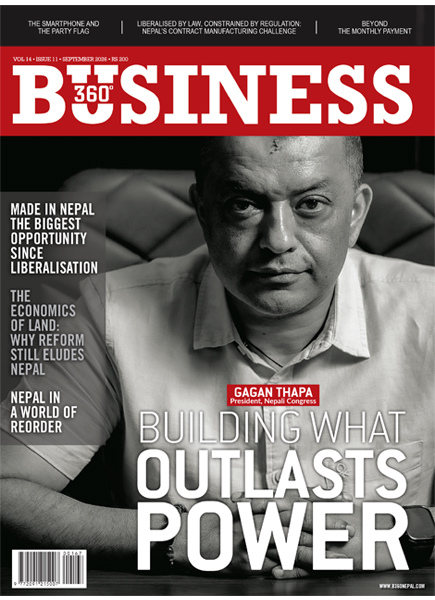
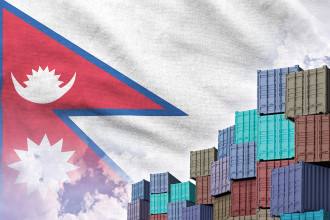
MADE IN NEPAL: THE BIGGEST OPPORTUNITY SINCE LIBERALISATION

-1789293497.jpg)
Governments do not create prosperity, economies do. And today, three powerful forces are converging to rewrite economies everywhere.
The first is geopolitics. The world is fragmenting into competing economic blocs, and companies are redesigning supply chains around resilience rather than efficiency alone. Friend-shoring, China+1 and India+1 are no longer boardroom buzzwords, they are investment strategies deciding where the next billion dollars in manufacturing will flow.
The second is artificial intelligence. AI is shrinking the importance of geography in services while raising the value of specialised manufacturing. Smart factories, robotics, digital twins, AI-powered logistics and automated quality control now let smaller nations compete, provided they have clean energy, reliable infrastructure and digitally skilled workers. Countries that once relied solely on cheap labour are competing instead on technology, talent and speed.
The third is demography. Around the world, ageing economies are hunting for workers while developing nations are losing theirs. Nepal continues to export hundreds of thousands of young people every year. The defining economic question of this decade is no longer how many workers leave Nepal, but how many high-value jobs can be created before they do.
This convergence hands Nepal its most consequential economic opportunity since liberalisation in the 1990s. The country’s greatest export should no longer be its youth, it should be the products, technology and intellectual property they create.
Nepal sits between the world’s two fastest-growing major economies. It has rapidly expanding hydropower, improving digital infrastructure, growing entrepreneurial ambition, and a generation that is digitally native rather than digitally adapting.
Imagine an economy where AI-powered agro-processing exports Himalayan food products with full blockchain traceability; where electronics are assembled on clean hydropower; where drones, medical devices and specialised outdoor equipment are manufactured for regional markets; where Nepali software engineers build AI applications while the factory next door manufactures the hardware that runs them.
That vision is no longer unrealistic. The technology exists. The capital exists. The markets exist too. The only question is whether Nepal’s institutions can move fast enough to capture them.
History rarely offers second chances. The post-Cold War era gave Nepal liberalisation. This post-pandemic, AI-driven, geopolitically fragmented world may offer something bigger still: the chance to become a trusted manufacturing and innovation partner in Asia.
But only if Nepal stops debating yesterday’s economy and starts building the economy of 2035. In this Opinion section of Business 360, we reached out to Siddhant Raj Pandey, CEO, Business Oxygen; Kailash Bijayananda, COO, Leapfrog Technology; Anubhav Shrestha, President, NYEF Kathmandu Chapter; Shambhu Babu Koirala, CEO and President, Agro Tech; Bishant Neupane, CEO, Le Monal Chocolates; Amigo Khadka, Co-Founder, Nepal Tea Collective; and Kreeti Shakya, CEO, Alchi.
Because in 2026, ‘Made in Nepal’ is no longer just a branding exercise. It is a geopolitical strategy.
Has the post-September political reset fundamentally changed Nepal’s economic trajectory, or will the Gen Z movement ultimately be judged by whether it creates jobs rather than simply changes governments?

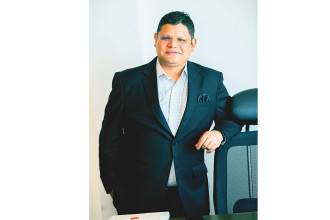
SIDDHANT RAJ PANDEY, CEO, Business Oxygen
Siddhant Raj Pandey: It’s a bit early to say. The new government was formed at a time when Nepal has internal issues of its own, and internationally, economic conditions are in flux - the turmoil in West Asia is causing disarray globally, and we are not immune to it. That said, the Gen Z movement that led to the elections has given us a government with almost a two-thirds majority, which has ignited hope within the country and goodwill from outside.
That support is expected to bring the transformational changes the economy needs. The newly announced budget, with its expansionary fiscal policy, higher public spending, income tax cuts and structural reform, should boost the economy. Let’s give the government some time for this to materialise into jobs. I am hopeful.
Shambhu Babu Koirala: Every major political shift reshapes a nation’s trajectory, but human systems naturally gravitate toward the path of least resistance, often slipping back into old habits once the dust settles.
The September reset was extraordinary even by Nepal’s protest standards. Nearly a year on, though, the picture is mixed rather than uniformly bullish: domestic markets have stabilised and actual FDI inflows more than doubled in the fiscal year that just closed, yet new investment commitments fell for a second straight year, with instability cited as the reason. Capital already inside the country is growing more comfortable; capital still outside is watching.
That gap is the real test. If this momentum is institutionalised into concrete reforms and high-value domestic jobs, turning hesitant capital into committed capital, the Gen Z movement will be remembered as the moment Nepal changed course. If it is not, it will face a harsher verdict than every transition before it, precisely because it promised more.
Kailash Bijayananda: The political reset was historic, but an economic reset has not happened yet. If young Nepalis still see migration as their best economic opportunity five years from now, the movement will have fallen short economically. More than anything, we are all hoping for predictable policy.
Anubhav Shrestha: The recent Gen Z-led political reset has injected a sense of optimism into Nepal, encouraging young people to raise their voices and securing promises of government transparency. But a change in leadership does not automatically equate to economic transformation. The country’s economic trajectory remains highly challenging and will take significant effort to rebuild. Without tangible economic progress, this transition risks being viewed as a superficial change of face rather than a true catalyst for national prosperity. Rebuilding private-sector confidence is also essential to making the economy prosper.
Ultimately, the movement’s success will be judged by its ability to foster an environment that creates jobs, not merely changes governments. This aligns with Nepal’s broader macroeconomic opportunity, driven by shifting global geopolitics, the rise of artificial intelligence and changing demographics. To truly capitalise on this convergence, the nation must shift its focus from exporting youth labour to leveraging its digitally native generation building an economy that exports locally created products, technology and intellectual property instead.
Bishant Neupane: Political change is important, but ultimately people will judge it by what changes in their everyday lives. For me, the real test is not who is in government, but whether young Nepalis can see a future here.
If we can create good jobs, build businesses, increase exports and give young people opportunities to use their skills in Nepal, the movement will have had a real economic impact. Otherwise, changing governments alone does not change the economy.
As a business owner, I see this simply: young people do not necessarily want to leave Nepal, they leave because they do not see enough opportunities here. Changing that would be real progress.
Amigo Khadka: Not really, not yet. The political reset has changed the government and disrupted the status quo to some extent, but I do not think it has fundamentally changed Nepal’s economic trajectory. The underlying system - how the state operates and how governance is delivered - is still broadly the same.
The Gen Z movement was also about much more than employment. It was a revolt against a way of life and a way of being governed. People were tired of hearing about corruption scandals, poor governance and political impunity. Even the social-media ban became symbolic of a larger problem: the perception that political power had become so entrenched that governments could make decisions without sufficiently considering the people they governed. What people wanted was a better quality of life and a sense that the state should work for them - better infrastructure, education and healthcare, but also fewer scandals, less corruption, better public services, and a government that helps people deal with inflation and economic insecurity. Employment is obviously one of the most important parts of that equation, but it is not the entire equation.
So yes, the Gen Z movement will ultimately be judged partly on whether it creates better employment opportunities, but more broadly on whether people’s economic trajectory actually improves. The test is whether people feel they deserve - and are actually receiving - a better quality of life than previous governments provided.
A change in government is political change. A change in people’s economic prospects is economic change. Nepal has achieved the first; the real question is whether we can now achieve the second.
Kreeti Shakya: The post-September political reset has changed Nepal’s political mood, but its real success will be judged by whether it creates jobs and economic opportunity. The Gen Z movement rose from frustration with unemployment, weak governance, corruption and a lack of hope. If this change brings transparency, faster approvals, cleaner procurement, startup-friendly policy and private-sector confidence, it can become a turning point. If not, it will be remembered as just another political change without economic transformation.
As AI transforms manufacturing, logistics and global services, where should Nepal place its biggest bet over the next decade: advanced manufacturing, AI-enabled services, green industrialisation or a combination of all three?
Siddhant Raj Pandey: Nepal has lagged on all fronts. We need to embrace the AI revolution and push our industries - including small and medium enterprises - to incorporate some form of agentic AI into their businesses. At a time when most of our businesses haven’t even considered Environmental, Social and Governance (ESG) measures, embedding AI is a tall order. Climate change is an unavoidable fact; small measures such as insuring plants and equipment are an essential step toward adaptive resilience. This needs to be propagated more widely.
If we move forward without incorporating AI, we will lose to others. I do not think Nepal can compete through advanced manufacturing, that is not our forte. We need to concentrate on SMEs, especially in agriculture and services, incorporating agentic AI into our businesses and introducing climate-smart approaches.
Shambhu Babu Koirala: Having worked in Silicon Valley and Boston alongside leading tech experts, while also operating directly in Nepal’s agriculture, agro-processing and agro-manufacturing sectors, my perspective is rooted in both technological capability and industrial reality.
Nepal should focus strictly on areas where we hold an absolute competitive edge: manufacturing products that cannot easily be replicated elsewhere. Competing with major economies on conventional advanced manufacturing, where they already dominate logistics and scale, is a losing game. Our edge lies in unique climatic zones and flora and fauna found almost nowhere else. Native Himalayan bio-resources - Chiuri butter, high-altitude cardamom, orthodox teas from Ilam - let us target high-value, specialised global markets that scale alone cannot win.
In services, our primary asset is our cultural and geographical diversity. Rather than relying on low-margin AI service outsourcing for quick bucks, we should deploy AI to market our tourism assets, optimise logistics and showcase Nepal to the world.
On green industrialisation, I will say it plainly: hydropower is the only real asset we have. We have no strong case elsewhere in that category, no major minerals, no coastline, no existing heavy industry to convert to clean energy. What we do have is abundant, largely untapped hydropower, and that is nothing to dress up as a weakness. Used well, it becomes the foundation under everything else - the low-carbon edge that lets hyper-specialised manufacturing reach buyers who pay a premium for exactly that story.

KAILASH BIJAYANANDA, COO, Leapfrog Technology
Kailash Bijayananda: A combination of all three but maybe not equally. Export intelligence first, use green energy to industrialise second, and build specialised manufacturing around both.
Anubhav Shrestha: Over the next decade, Nepal should place its biggest bet on a synergistic combination of all three: green industrialisation, AI-enabled services and advanced manufacturing. Since the nation cannot focus on all three at once, it must sequence this strategy around its most significant structural input - clean electricity - first, then build out from there.
Hydropower is Nepal’s greatest comparative advantage; by resolving the private sector’s current struggles with stable electricity, the country can build a robust green industrial foundation that capitalises on global demand for zero-carbon industry.
This clean-energy foundation must be paired with Nepal’s most critical demographic asset: a young, English-capable, digitally native workforce. Because the country’s landlocked geography heavily penalises traditional, logistics-heavy physical exports, channelling surplus green electricity into the IT sector lets Nepal establish zero-carbon data centres and build high-margin, AI-enabled services - bypassing physical borders entirely to export globally competitive digital solutions. As this digital ecosystem matures, Nepal can then use both AI and reliable clean power to fuel advanced manufacturing, moving from low-margin, bulk goods to high-value, sustainable, precision-engineered products for the international market.
Bishant Neupane: I do not think Nepal should put all its money in just one area. I think our opportunity is in combining manufacturing, AI-enabled services and green energy.
AI can make even a small Nepali company far more productive — it can help with design, accounting, marketing, logistics, customer service and even manufacturing processes. At the same time, Nepal has huge potential in hydropower, so we have an opportunity to build industries around relatively clean energy. And I still believe physical manufacturing is extremely important. We should not become a country where everyone works on a laptop while almost everything we consume is imported.
For a company like mine, for example, I want to source more ingredients, packaging, machinery and skills from Nepal over time. That creates an ecosystem around one product. That is the kind of economy I would like to see Nepal build.
Amigo Khadka: Nepal should not bet everything on one sector, since economies rarely develop that way. The real question is what mix of technology, energy, talent and geography gives Nepal genuine competitive advantage. Nepal has abundant clean energy (hydropower and other renewables), a young, digitally savvy workforce, and a strategic position between India and China. AI-enabled services stand out because AI acts as an equaliser, reducing the importance of geography and letting Nepali companies serve global customers with far less disadvantage than before. I see this at Nepal Tea Collective, where AI now makes it easier to create culturally relevant content for American audiences, and more broadly lets small teams operate like larger organisations.
I am less confident about conventional manufacturing as Nepal’s edge. AI-driven automation erodes the low-labour-cost advantage developing economies traditionally relied on, and Nepal’s landlocked status and small domestic market compound the challenge.
Instead, I see opportunity in high-value, low-volume exports, such as premium tea, coffee and agricultural and medicinal products, where Nepal’s geography, biodiversity, and culture create real differentiation. Green industrialisation is another opportunity: using hydropower not just for export but as an input for a cleaner economy, as seen in Nepal’s EV adoption. My combined strategy is AI-enabled services, green industrialisation and specialised high-value production, while staying cautious about pursuing mass manufacturing.
Kreeti Shakya: Nepal should bet on a combination of green industrialisation, AI-enabled services and selective advanced manufacturing. Nepal cannot compete with India, China, Vietnam or Bangladesh on scale, but it can compete through clean energy, young technical talent, niche manufacturing, design-led products and AI-enabled services. Hydropower should not only be exported; it should power Nepal’s own industries.
The world is reorganising around friend-shoring, economic security and resilient supply chains. How can Nepal leverage its strategic location between India and China without becoming caught in geopolitical competition?
Siddhant Raj Pandey: We sit between two of the world’s largest, fastest-growing economies, home to the largest populations on earth. If you were choosing a neighbourhood for future prosperity, this would be it. However, we have failed miserably in the past to take advantage of our geopolitical and economic position. We should be the bridge between these two nations, participating through connectivity. We have already started, at a small scale, trading hydropower with our neighbours - an example of friend-shoring. Nepal is also well placed to build environmentally sustainable data centres; if we can offer these services at competitive pricing, we will have a real chance. We need to do more research on this, and quickly, we may miss the boat again if we do not act with urgency.
Shambhu Babu Koirala: In past years, Nepali businesses chased Europe, the Middle East and East Asia for premium markets, largely looking past the two giants next door. That was not foolish at the time: both neighbours had massive populations but not yet the disposable income to serve as high-value consumer markets.
That has fundamentally changed. Today, India and China have two of the world’s fastest-growing middle classes - each with roughly 1.4 billion people, nearly 2.9 billion combined, right on our border. To capitalise on this while avoiding geopolitical friction, Nepal must maintain strict neutrality through concrete, symmetrical policies, such as offering identical treatment to both neighbours on air connectivity and trade access. Executed effectively, high-yield regional tourism alone could become a major economic driver.
Furthermore, our digital talent does not need to conquer the entire globe to build transformative tech enterprises. A Nepal-built platform that captures even a small fraction of that combined consumer base - the equivalent of an Uber or Zomato built for this market - would instantly become the largest, most valuable company Nepal has ever produced.
Kailash Bijayananda: India is the natural market for Nepali manufacturing, given the open border, established trade links and transit infrastructure. China, meanwhile, can be an important source of investment, machinery, technology and industrial know-how. Diversification is perhaps our best protection against geopolitical risk. Rather than seeing Nepal simply as a bridge between India and China, we should leverage our unique geopolitical position to build an economy that is valuable to India, China and to the rest of the world, without having to choose sides.

ANUBHAV SHRESTHA, President, NYEF Kathmandu Chapter
Anubhav Shrestha: The global shift toward friend-shoring and resilient supply chains presents a massive, untapped opportunity for Nepal, if the country leans into its unique strengths rather than its traditional geographical constraints. Being landlocked poses logistical hurdles for heavy, conventional manufacturing, but it also forces Nepal to innovate and bypass physical borders entirely by pivoting into the digital knowledge economy and high-value precision engineering. This aligns well with a world reorganising around economic security, letting Nepal leverage its location without becoming entangled in geopolitical competition.
Furthermore, Nepal can capitalise on the massive economic size of both India and China by acting as a strategic node for specific industries. While China has historically served as a global manufacturing hub, the current shift of supply chains towards India opens up a highly lucrative niche. Specifically, Nepal can position itself to handle assembling and contract manufacturing, integrating smoothly into these evolving regional supply chains. By focusing on these specialised manufacturing roles alongside its digital pivot, Nepal can extract immense economic value from its strategic location while maintaining its neutrality.
Bishant Neupane: I think Nepal should keep the approach very practical: business should come before politics. We sit between two of the world’s largest markets. Instead of thinking of India and China only as political neighbours, we should think about them as enormous markets, suppliers, sources of technology and potential partners.
Nepal does not need to compete with India or China in everything. We need to identify the things we can do well and use our location to connect to both markets. If Nepal becomes a reliable place to manufacture, process, design or provide services for companies operating in the region, our geography becomes an advantage.
Amigo Khadka: Nepal should not think of its position between India and China simply as a geopolitical vulnerability. It can also be an extraordinary economic opportunity.
India and China are both major economic powers, but they are very different markets - different political systems, consumer markets, industrial structures and approaches to the world. Nepal has the opportunity to sit between those two systems and become a trusted, neutral economic partner. For countries and companies that do not want to choose between India and China, Nepal can offer a different proposition: a stable, predictable partner positioned between two enormous markets. In that sense, I sometimes think of the opportunity as closer to the role Singapore has played in Asia - not in trying to replicate Singapore’s financial system, but in being a small, trusted, relatively neutral place through which global capital, businesses and ideas can interact with the wider region.
There is also an immediate opportunity that we have barely captured. India and China together represent an enormous nearby market for high-value Nepali products, yet we have not been particularly successful at taking our agricultural and specialty products into either market at scale. For a company like Nepal Tea Collective, this is particularly relevant. We should be thinking not only about selling Nepali products to the US or Europe, but also about what a premium Nepali product can mean in the two enormous markets immediately around us.
Beyond physical products, Nepal can position itself around digital services, tourism, education and other knowledge-intensive industries. But geography by itself is not enough. To become this kind of neutral economic hub, Nepal needs political predictability, policy consistency, ease of doing business and credible institutions. Our objective should not simply be to become the easiest place to export from; it should be to become one of the most desirable small economies in the region for companies and capital that value neutrality, location, stability and access.
Kreeti Shakya: Nepal should not try to compete with India or China in mass manufacturing. Instead, it should build a niche that complements both. Nepal can become a green, neutral, trusted hub for design, digital services, tourism, light manufacturing, agro-processing and climate-related industries. It must improve infrastructure, customs, air connectivity, legal certainty and investor confidence.
Nepal exports talent but imports technology. What policy reforms would encourage Nepali entrepreneurs, engineers and the diaspora to build globally competitive industries at home instead of overseas?
Siddhant Raj Pandey: I do not think there should be any policies or regulations that inhibit technology. Technology moves so fast that policy reforms will never be able to keep up with it. If there must be policies, they should be broad guidelines that ensure cybersecurity and intellectual property rights. There have been marked developments recently in the ICT sector to create an enabling environment for its progress. Many companies relied on outsourcing business from abroad in the past, largely SaaS, but with the proliferation of AI, these businesses are losing out. Companies that can build AI products and services to assist other industries may have the best chance of survival.

SHAMBHU BABU KOIRALA, CEO & President, Agro Tech
Shambhu Babu Koirala: Importing technology is not a failure, it is a shortcut we should take without guilt. A small nation with limited R&D budgets has no business trying to invent basic technology from scratch when it can leapfrog straight to using it. What we cannot import is our own identity, and that is where we keep losing.
A significant share of what the world buys as Darjeeling tea is actually high-altitude Nepali leaf, grown in Ilam and blended across the border because Darjeeling’s own gardens can no longer meet global demand. Much of our raw chhurpi trade follows the same pattern, crossing informally into Indian hill markets and losing its Nepali identity before it ever reaches a shelf. We grow the value; someone else banks the brand. That is not a market failure, it is a policy failure, and exactly the kind of gap that should worry anyone wondering why our engineers and entrepreneurs do not see a future in building here.
Three things I would put into policy. First, a protected ‘Himalayan Origin’ geographical indication tag, so products like Chiuri butter, Ilam tea and chhurpi are legally ours, not just agronomically ours. Second, real quality infrastructure, digital traceability and organic certification strict enough that our exports clear premium markets without a foreign label doing the trust-building for us. Third, pick our version of what Taiwan did with semiconductors: a small country that could not compete at industrial scale, so it went all in on one niche until the world could not build a chip without it. Nepal has its own version of that niche sitting in its bio-resources. Protect it, certify it, and build it into an industry worth staying home for.
Kailash Bijayananda: The provision allowing foreign-income-generating tech companies to establish subsidiaries outside Nepal was a good start. We have to make it dramatically easier to start, fund and scale companies, both in and outside Nepal. A good next step would be to simplify licensing, taxation, foreign-exchange rules and capital controls, so entrepreneurs spend less time navigating bureaucracy and more time building businesses.
Anubhav Shrestha: Nepal is currently exporting its sharpest minds while importing nearly everything else, resulting in a staggering trade deficit. To reverse this talent drain, policy reforms must remove bureaucratic friction and unleash domestic innovation. First, regulatory sandboxes are essential, letting local engineers and entrepreneurs build and scale AI, blockchain and fintech solutions without being tangled in policy and compliance hurdles before they even launch.
Second, Nepal must strategically engage its global diaspora, not merely as a source of remittance, but as the country’s soft power. The Nepali diaspora holds immense technical expertise, specialised skills and global market knowledge that can be transferred back home alongside their financial capital. Policymakers should establish dedicated diaspora funds to invest directly in domestic startups, paired with targeted instruments such as diaspora bonds and durable non-resident investment vehicles.
Combined with simplified profit repatriation and aggressive R&D tax credits, this would channel global Nepali wealth and knowledge into productive equity rather than just household consumption, helping the nation finally scale its own tech ecosystems.
Bishant Neupane: The first thing is to make it easier to build a company in Nepal. Today, an entrepreneur can spend an unreasonable amount of time dealing with paperwork, imports, taxes, approvals and uncertainty. For a small company, those are not small problems, they can stop you from growing altogether.
We also need better access to technology and machinery. If I want to bring a machine into Nepal that will help me manufacture a better product, the process should be straightforward.
And we need to make it easier for the Nepali diaspora to invest, mentor and build businesses here. I do not think we should simply tell young people, ‘Do not leave Nepal.’ We should make Nepal appealing enough that coming back becomes a smart career and business decision.
Amigo Khadka: I do not see Nepal exporting talent today as a failure. It can be part of development. Countries like South Korea and India went through periods where people studied and worked abroad, building capital and experience, and some of that eventually returned or stayed connected. The goal is to make migration a source of capability, not permanent loss. Nepal should focus on what it is genuinely competitive at now, while making it easier for people with overseas experience to engage with home.
That means regulatory reform: easier company formation, easier access to technology and machinery, easier capital raising and repatriation of returns. Nepal has been more conservative on cross-border capital flows than comparable ecosystems in Africa and India, where startups move capital far more flexibly. Nepal needs to ask if its restrictions still fit the economy it wants.
There are real concerns around money laundering and financial stability. Openness does not mean dropping safeguards, just designing smarter ones. The diaspora matters too, not just as remittance senders but as investors and bridges to global markets. The goal is not bringing everyone home. It is letting Nepalis abroad build in Nepal without losing their global connections.
Kreeti Shakya: Nepal exports talent because better salaries and opportunities exist abroad. To change this, Nepal must make it easier for foreign companies, franchises, diaspora investors and global businesses to enter and operate. It also needs better access to capital, venture funds, tax incentives, and industry-linked education in AI, coding, manufacturing, product development and vocational skills.
If we look back from 2035, what single decision made in the next three years will determine whether Nepal becomes South Asia’s next manufacturing and innovation hub or misses another historic opportunity?
Siddhant Raj Pandey: First of all, I wish we could have stable governments, along with predictable, stable policies, to drive any change. Until then, nothing moves. We rank third in IT exports in South Asia, behind India and Pakistan, but lag behind Bangladesh and Sri Lanka in IT ecosystem. Our policies should be facilitative, we have a tendency to let innovation be stunted by regulation, when it should be the other way around. I would let the market evolve and want the least government intervention possible. Otherwise, we will miss another opportunity.
Shambhu Babu Koirala: Split manufacturing into two groups. One: high-value goods that justify the expensive logistics of a landlocked country - organic, Himalayan-branded, pristine positioning. The other: low-value but essential goods for domestic consumption only - poultry, fish, fruits and vegetables, cereal crops, organic fertiliser, not worth exporting but too important to keep importing. The second group protects the economy. The first group is what makes Nepal known.
Our single most important decision in the next three years is declaring the Himalayan and hill regions an organic manufacturing zone - the way Sikkim did, but with the transition support and market infrastructure Sikkim initially lacked. That declaration means nothing on its own, though. Nepali law keeps primary agriculture, farming and production itself on a ‘negative list’ once foreign ownership crosses a certain threshold, off-limits to foreign-majority companies. It is meant to protect Nepali farmers, but it is written broadly enough to also block the scale of investment this organic zone would actually need. That means the serious capital this idea depends on, foreign or diaspora, hits the same wall every real manufacturing proposal hits today. Fix that rule for this zone specifically, pair it with clean hydropower already sitting unused, and organic status stops being a brand and becomes an industry.
Innovation follows the same logic. Our real edge is that same organic, low-carbon space, or Nepali-built creative and technical talent - the kind behind Incessant Rain Studios’ work for Hollywood. What that talent has proven is capability. What it has not yet proven is that the value it creates can stay home instead of listing on someone else’s exchange, which is exactly why the ownership question is the decision underneath all the others.
Kailash Bijayananda: I do not believe it comes down to one single decision. But if we double down on industries that are already taking shape - tech and energy - these could really change the game. It is not that nothing has happened so far; there has been progress. The problem is that the pace is excruciatingly slow.
Anubhav Shrestha: Looking back from 2035, the single pivotal decision made in the next three years will be whether Nepal commits to a unified policy that systematically monetises and integrates its core comparative advantages: natural resources, abundant hydropower and water, high-value tourism, and rapidly expanding IT services.
Instead of managing these as disjointed verticals, the critical choice is to build an interconnected ecosystem, where clean hydro energy powers zero-carbon digital infrastructure, sustainable resource use feeds domestic value chains, and modernised, high-yield tourism enhances global brand equity.
Committing to this integrated foundation within the next three years will determine whether Nepal capitalises on the global clean-energy transition and digital economy.
By channelling clean water and power into domestic industries, scaling IT service exports, and managing its natural and tourism assets with long-term strategic discipline, Nepal can lower operational costs, attract private capital and retain top talent. Deciding to aggressively execute this multi-pillar strategy now will be the defining factor between Nepal becoming South Asia’s growing manufacturing and innovation hub, or missing another generational window of opportunity.

BISHANT NEUPANE, CEO, Le Monal Chocolates
Bishant Neupane: For me, it would be making Nepal significantly easier to manufacture and export from. If we get that one thing right, many other things will follow. Give businesses reliable electricity, good infrastructure, predictable taxes, easier import of machinery and raw materials, access to finance and a much simpler export process. Then let entrepreneurs compete. We do not need the government to decide which companies will succeed. We need the government to create an environment where good companies have a chance to succeed.
Amigo Khadka: I am sceptical that one single decision determines Nepal’s trajectory. Countries are rarely transformed by a single policy; more often it is small decisions, consistently implemented over years, that shift an economy. There are exceptions, like India’s 1991 reforms or Nepal’s own liberalisation, but usually development is cumulative.
Nepal already has most of the plans and policies it needs. The real problem is execution. We do not need another hundred-page strategy - we need to implement what already exists, consistently. Still, a few choices carry outsized weight. One is how open Nepal wants to be to international capital: how easily foreign investors can move money in and out, and how open we are to multinationals. Greater openness carries risks like money laundering and capital flight, but excessive closedness has real costs too. Nepal needs to pick a place on that spectrum.
The second is how we tell Nepal’s story. Investors respond to fundamentals, but also to a credible vision of the future. Nepal could position itself as a neutral education hub for South Asia, a global centre for Himalayan and climate research, or simply build a decade of stable, predictable, pro-investment politics. That creates momentum, and momentum matters. So, if there is one overarching decision, it is choosing what kind of country Nepal wants to be economically, then making consistent choices that reinforce it.
Kreeti Shakya: The biggest decision is whether Nepal integrates AI and technology into business, education and government processes. This can create demand for technology experts across all sectors. Nepal does not lack ideas; it lacks execution discipline.
If a global manufacturer were deciding today between Nepal, Vietnam, Bangladesh and India, why would they choose Nepal, and if they would not, what must change immediately?
Siddhant Raj Pandey: Any manufacturer decides on the basis of economies of scale and factors of production, the policies of the host government, and connectivity to other markets. Besides connectivity to India and China, we have not, as of now, been very competitive on the other factors. Low foreign direct investment into the country is proof of that. We simply cannot compete with the cost of production in the Indian market. The government needs to revise its taxation laws to encourage domestic production. One example: the recent budget raised excise duties, which has made beverages made in Nepal more expensive than those coming from India.
Shambhu Babu Koirala: Today, no global manufacturer would choose Nepal for mass production. Trucking raw materials in, machinery across borders, and finished goods back out through landlocked routes imposes a logistics penalty that scale alone cannot overcome.
A manufacturer chooses Nepal only when the raw material is genuinely native and priced high enough that shipping costs become negligible. Exploiting tariff gaps - like importing palm oil for minor processing before re-exporting to India - is not a strategy, it is a loophole. It has collapsed three times in five years (2020, 2022 and 2025), each time India adjusted its duties, partly because Nepal’s actual value addition falls well short of what the exemption requires.
The real pivot is hydropower used not as a commodity to export cheap, but as a strategic offset. Nepal already curtails hundreds of megawatts it cannot use; pricing that power cheaply for domestic processors costs the state nothing and directly offsets what transportation costs. Pair discounted, clean power with native bio-resources like allo fibre, the Himalayan nettle textile only Nepal grows at scale, and Nepal becomes a real option, not for mass-scale manufacturers chasing volume, but for specialised processors chasing zero-carbon, high-margin production at a scale this country can actually support.
Until capital repatriation is predictable and clean power is treated as industrial infrastructure rather than an export commodity, global manufacturers will keep choosing Vietnam for scale, Bangladesh for cost, and India for market size, and Nepal will keep watching from the sidelines.
Kailash Bijayananda: Nepal has already lost the battle against Vietnam, Bangladesh and other regional countries. We have to play a different game. What Nepal needs is to become exceptionally easy and competitive in key sectors, where clean energy and talent give it an advantage.
Anubhav Shrestha: While Nepal offers the compelling promise of zero-carbon manufacturing through abundant clean energy, green branding alone is not enough to win over global manufacturers against established powerhouses like Vietnam, Bangladesh and India. Capital fundamentally seeks profitability, efficiency and operational predictability. If a manufacturer hesitates to choose Nepal today, it is because of prohibitive logistics costs, bureaucratic friction and operational bottlenecks. To become a viable destination, Nepal must immediately drive down the cost of doing business and drastically improve its business environment.
Achieving that requires clearing fundamental hurdles across infrastructure, trade and regulation. First, Nepal must slash transit and logistics costs by eliminating trade friction and delays at border checkpoints, so raw materials and finished goods move seamlessly. Second, the country must guarantee uninterrupted, low-cost electricity to industrial corridors by resolving seasonal power fluctuations and transmission bottlenecks. Finally, the government must deliver true ease of doing business through plug-and-play Special Economic Zones (SEZs) with genuine single-window clearance, streamlined FDI approvals, flexible labour laws, and hassle-free land acquisition. By making day-to-day operations frictionless and cost-competitive, Nepal can turn its green potential into an irresistible proposition for global industry.
Bishant Neupane: Today, I do not think Nepal would be the obvious choice for a large global manufacturer, and I think we should be honest about that. Vietnam has built a strong manufacturing ecosystem. Bangladesh has developed huge expertise in garments. India has scale, infrastructure and a massive domestic market.
Nepal cannot compete with them simply by saying, ‘We are cheaper’. We are not necessarily going to win that race. We have to compete on quality, specialised products, sustainability, skilled people and access to regional markets. For example, Nepal could become very good at smaller, high-value manufacturing rather than trying to become the world’s cheapest mass manufacturer.
As a chocolate company, I understand this very well. I do not want Le Monal to compete with mass-produced chocolate on price. I want us to compete on quality, story, craftsmanship and uniqueness. I think Nepal as a country can do something similar.

AMIGO KHADKA, Co-Founder, Nepal Tea Collective
Amigo Khadka: I do not think Nepal should be trying to win a manufacturing competition against Vietnam, Bangladesh and India. In most mass-manufacturing categories, the unit economics simply do not favour us. Vietnam has built enormous manufacturing ecosystems. Bangladesh has a deep competitive advantage in labour-intensive manufacturing. India has scale, infrastructure, capital and a huge domestic market. Nepal should not try to beat these countries at their own game. There may be individual global manufacturers for whom Nepal makes sense, and there may be valuable partnerships, but I do not think attracting mass manufacturers should be the centre of Nepal’s economic strategy.
Our opportunity is different: high-value, low-volume, high-authenticity products. If something is made in Nepal, there should be a reason why the customer wants it to be made in Nepal. The Himalayas, biodiversity, craftsmanship, clean energy, culture and origin can all contribute to that value. Tea is a simple example. Nepal does not need to produce more tea than India or compete with the world’s largest tea-producing countries on commodity pricing. We can compete on origin, quality, altitude, craftsmanship, traceability and the story of the Himalayas. That is the model we are trying to build through Nepal Tea Collective.
The same thinking can apply to specialty coffee, medicinal and aromatic plants, premium agricultural products, wellness, outdoor products, tourism and other categories where authenticity and provenance matter. There are many small countries that have built successful economies without competing on mass-market manufacturing scale. Switzerland did not become Switzerland by trying to manufacture everything cheaply. Singapore built a very different value proposition around its position, institutions and connectivity. Nepal should therefore ask a different question: not ‘How do we become the next Vietnam?’ but ‘What can only, or best, be made, experienced or built in Nepal?’ That is where our competitive advantage lies.
Kreeti Shakya: Today, they may not choose Nepal for large-scale manufacturing. They may choose Nepal for clean-energy-based, niche, South Asia-facing operations. Nepal must improve approvals, logistics, land access, policy certainty, exports and repatriation.
What will define economic success for Nepal by 2035: exports, innovation, manufacturing, energy, digital services, or the ability to combine all of them into one national strategy?
Siddhant Raj Pandey: All of the above, with a focus on hydropower and other renewable energy technologies such as bio-pellets, digital services and high-value agro-processed goods. Any form of export will add value to the country, beyond the ones already mentioned. We need to slowly wean ourselves off exporting labour — we will need that workforce at home to drive the economy. Until then, our labourers working abroad remain our biggest export, anchoring our economy.
Shambhu Babu Koirala: It depends entirely on where policy puts its priority. Let us look at these one by one.
Exports succeed if we stop exporting people and start exporting brands and experiences — goods carrying a Nepali name, tourism built on what nowhere else has. And the two feed each other: a traveller who experiences the Himalaya becomes a customer for chiuri butter or Ilam tea long after they have gone home. Manufacturing only works if we run two tracks at once: domestic production that cuts what we import, and niche, Himalayan-branded goods for what we export , not the mass-scale game India, Vietnam and Bangladesh have already won. Energy is not a commodity to sell cheap across the border; it is the enabler that makes the other two possible, powering processing and production with what we are already leaving unused on the table. Innovation and digital services will not come from chasing what better-funded economies are building. They come from pointing AI at the industries where we already have an edge -automating logistics, proving quality, putting our producers in front of buyers who would otherwise never find us.
Put together: three real drivers - tourism, domestic production and niche export manufacturing - running on two enablers: cheap clean energy and digital tools in service of the other three. Managed as five separate ministries, we stay a low-margin economy exporting labour and unused power. Run as one machine, Nepal becomes the high-value, zero-carbon hub this region does not yet have. That gap is exactly what 2035 will judge us on.
Kailash Bijayananda: Energy can definitely become the foundation, but exports, innovation, manufacturing, energy and digital services should not be treated as separate strategies - they need to reinforce one another. Nepal does not necessarily need another national vision; it needs execution. And the private sector must be at the centre of it. Much of Nepal’s economic progress so far has been driven by private enterprise, often despite significant constraints. By 2035, success should mean creating an environment where entrepreneurs can invest, innovate, manufacture and compete globally. The government’s role should be to enable that ambition, with the private sector driving it.
Anubhav Shrestha: Economic success for Nepal by 2035 will not be defined by any isolated vertical, but by the ability to combine exports, innovation, manufacturing, energy and digital services into a single, cohesive national strategy. Rather than treating these as competing priorities, integrating them lets Nepal transition from a remittance-dependent model toward a resilient, self-sustained economy. At the core of this unified roadmap must be an aggressive focus on human capital - continuously upgrading workforce skills so local talent can power high-tech manufacturing, software services and green-energy infrastructure alike. By aligning skill development directly with industrial and digital needs, Nepal can ensure domestic innovation translates into tangible, high-value productivity.
There are genuine grounds for hope: for the first time, Nepal simultaneously has a governing mandate strong enough to reform, a demographic and diaspora base hungry to build, a structural clean-energy advantage the rest of the region is paying premiums to acquire, and a global supply-chain reshuffle that rewards exactly the kind of neutral, low-cost, green-powered node Nepal can be in the future.
Bishant Neupane: I would say the combination. You cannot build a strong economy by looking at these things separately. Cheap, reliable energy supports manufacturing. Manufacturing creates jobs and exports. Technology makes manufacturing more efficient. Digital services create new businesses. Exports bring foreign currency into the country. And skilled people make the whole system stronger. So, I do not think Nepal needs one ‘magic industry’ - we need an ecosystem. That is where Nepal has a real opportunity. We are a small country, which means we should, in theory, be able to coordinate these things far more easily than very large economies.
Amigo Khadka: It is the ability to combine them, with one qualification: Nepal needs to define not just what it wants to do but what it does not. Small successful countries have clarity about their economic identity. Bhutan built a distinct national proposition, Singapore built around being a trusted global hub, Switzerland around specific high-value capabilities rather than competing everywhere. Nepal needs that same clarity: high-value agriculture over commodity farming, specialised digital services over becoming another mass tech hub, clean energy over energy-intensive industry, and education, tourism and dialogue where our geography gives natural advantage.
I would also like Nepal to be ambitious about its story. Could it become a peace and dialogue hub, drawing on being the Buddha’s birthplace? A neutral education hub for a tense region? A centre for Himalayan ecology and climate research? Could Kathmandu host global conversations on climate and development? These stories are not separate from economics — they feed investment, tourism and talent. That is what Nepal Tea Collective tries to show: taking something Nepal already has and adding branding, quality and global access, proving Nepal can win by being distinctive rather than cheapest. If by 2035 the world has a clear answer to ‘Why Nepal?’ the numbers will follow.

KREETI SHAKYA, CEO, Alchi
Kreeti Shakya: Success will come from combining energy, manufacturing, exports, innovation, digital services and talent into one national strategy.